
Hen Harrier
Circus cyaneus
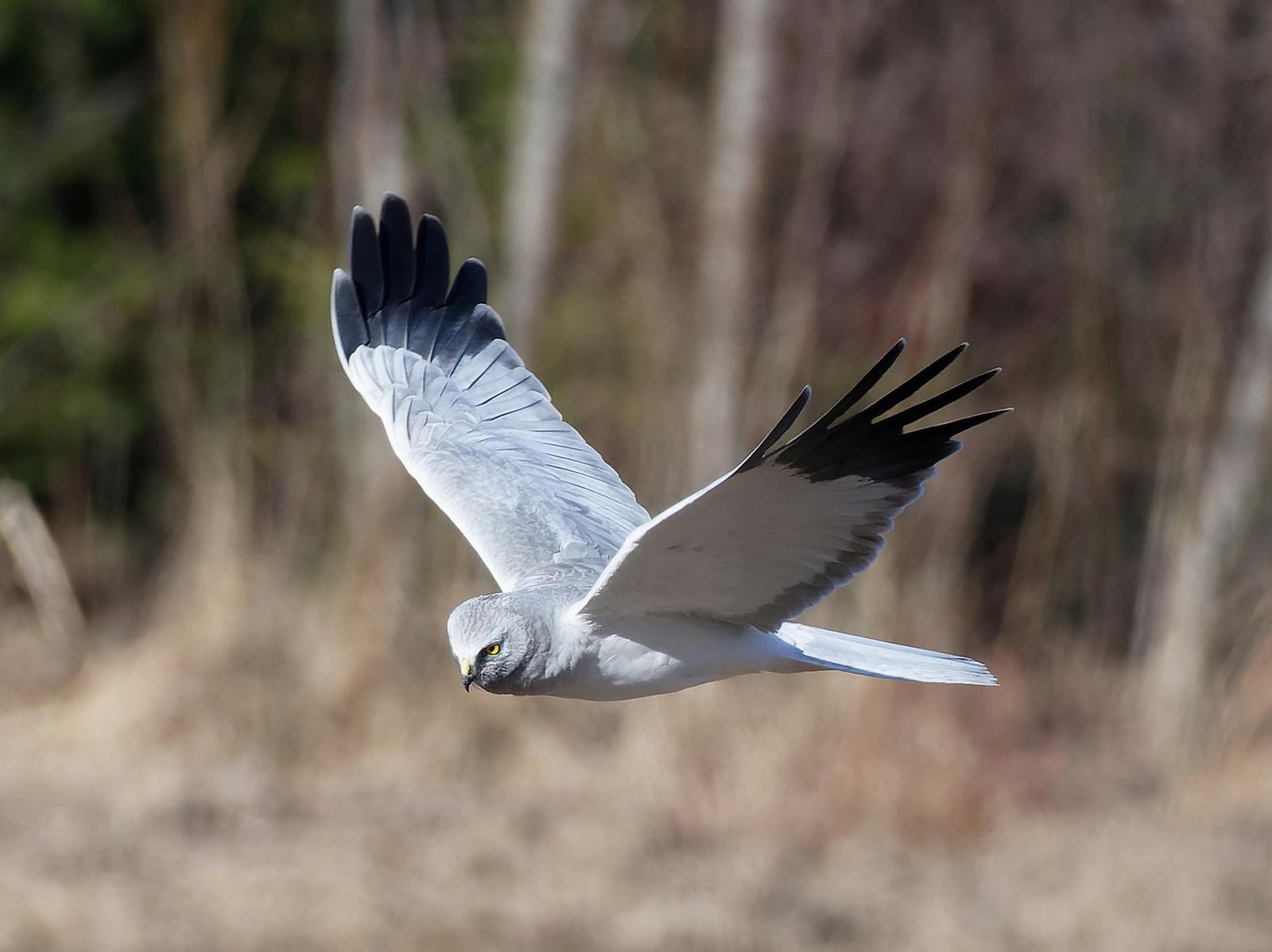
Den blå kærhøg er en rovfugl i høgefamilien, der måler ca. 47 cm og har et vingefang på 110 cm. Hannen har blågrå vinger med brede sorte spidser, mens hunner og ungfugle er brunlige med tværbåndet hale.
Start with the broad white , visible in grey and brown alike. males are grey above, black-tipped in the wings and white on the belly; females and young birds are brown and streaked. When hunting close to the ground in open country, the wings are often slightly raised. Flight tends to look calmer than Montagu’s.
Can be confused with
- Pallid Harrier — An adult male Pallid typically shows an isolated dark wedge surrounded by pale outer-wing feathers. In male Hen, black covers the tip and follows the rear margin towards the body. Young male Pallids can retain dark feathers along the inner-wing margin despite an adult-like outer wing; that margin alone is inconclusive.
- Montagu's Harrier — Compare adult males from above: Montagu’s has grey and darker panels, plus a narrow black stripe through the inner wing. Hen looks more evenly grey, with black at the tip and rear margin. A fully spread wingtip can show five fingers in Hen; Montagu’s usually shows four and has a longer, sharper outer wing. An oblique view can make counting unreliable.
- Western Marsh Harrier — A heavy harrier without the white rump suggests Marsh rather than Hen. Male Marsh combines rufous-brown areas with grey inner-wing feathers; females have a dark body contrasting with cream around crown, nape and throat. The broad rump patch remains useful for brown female and juvenile Hens.
Facts
Wingspan
110 cm
Conservation status
ikke truet
Family
hawks, kites and eagles
Accipitridae
Read more
This is a short overview for the quiz. For the full account, go to the sources:
- Danmarks Fugle at the Danish Ornithological Society (in Danish)
- Wikipedia (in Danish)The description above is from Wikipedia (CC BY-SA 4.0).
This page brings together information from several sources. If you spot a mistake, write to hallo@magnify.dk.