
Montagu's Harrier
Circus pygargus
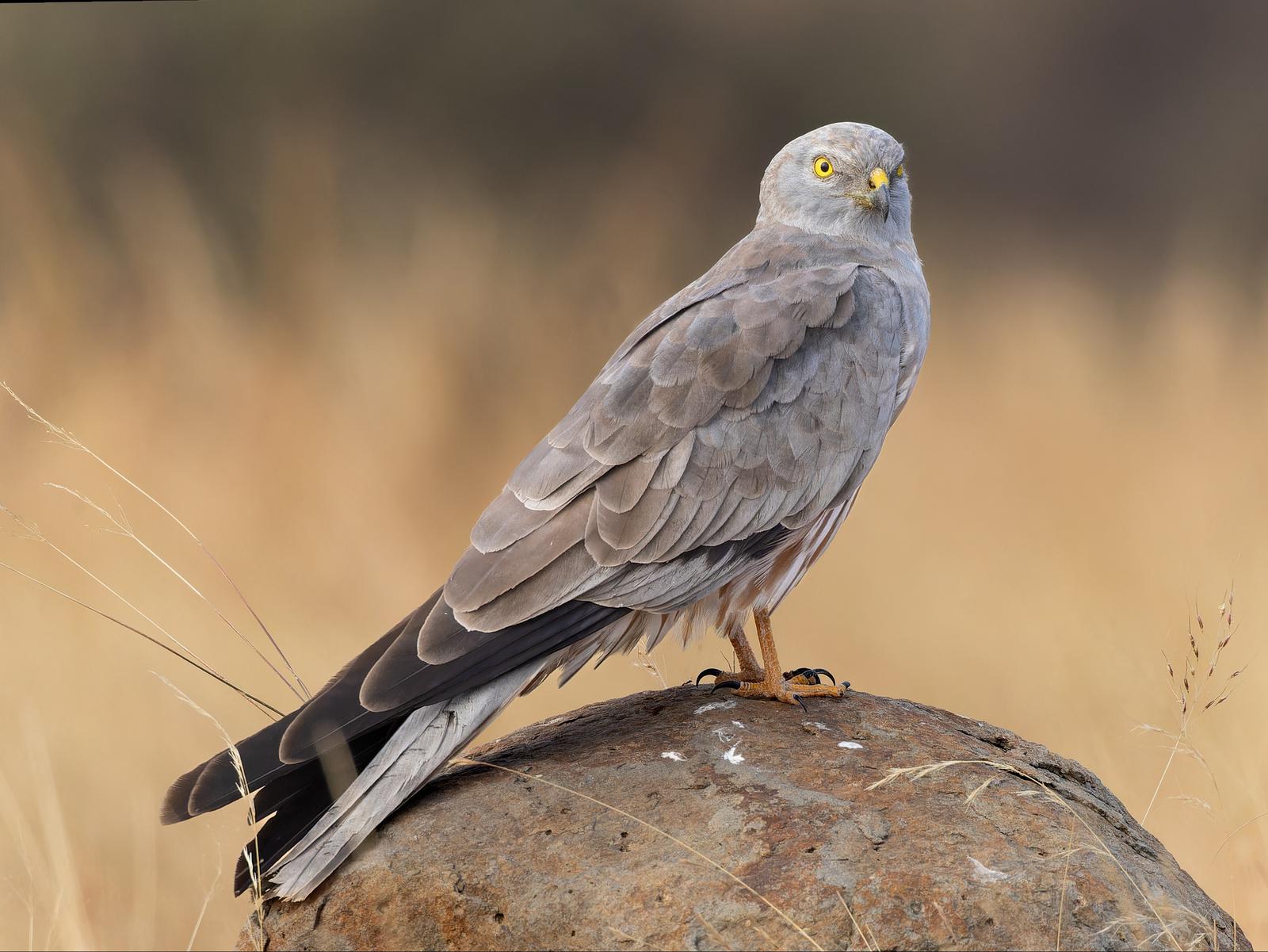
Hedehøg er en elegant bygget rovfugl med lang hale og smalle, spidse vinger. Det er den mindste af de slanke, langbenede kærhøge.
In an male, look for the narrow black stripe through the inner wing, most easily seen from above. Pale grey contrasts with darker wing panels and a broad black outer wing; rusty streaks mark the belly. The bird looks lightly built, with a long tail and slender, elongated wings. A fully spread, pointed outer wing usually shows four fingers. Flexible wingbeats give a buoyant impression. The looks less conspicuously white than Hen’s, and the female has a narrower white patch.
Can be confused with
- Hen Harrier — Hen has a heavier build and broader wings with a rounder outer section. A clear view of its spread wingtip can show five fingers. Adult male Hen lacks Montagu’s rusty belly streaks and inner-wing stripe; its black tip continues along the rear margin. The white rump is broad in male and female Hen, less conspicuous in male Montagu’s and narrower in female Montagu’s.
- Pallid Harrier — Adult male Pallid looks very pale and lacks Montagu’s rusty belly markings and inner-wing stripe. Its dark wing marking is normally an isolated wedge in the outer section. Pallid has a shorter, narrower outer wing relative to its inner wing; Montagu’s outer section is more elongated and pointed.
Facts
Wingspan
109 cm
Conservation status
ikke truet
Family
hawks, kites and eagles
Accipitridae
Read more
This is a short overview for the quiz. For the full account, go to the sources:
- Danmarks Fugle at the Danish Ornithological Society (in Danish)
- Wikipedia (in Danish)The description above is from Wikipedia (CC BY-SA 4.0).
This page brings together information from several sources. If you spot a mistake, write to hallo@magnify.dk.