Fuglequiz
QuizDailyResultsAbout

Pallid Harrier

Circus macrourus
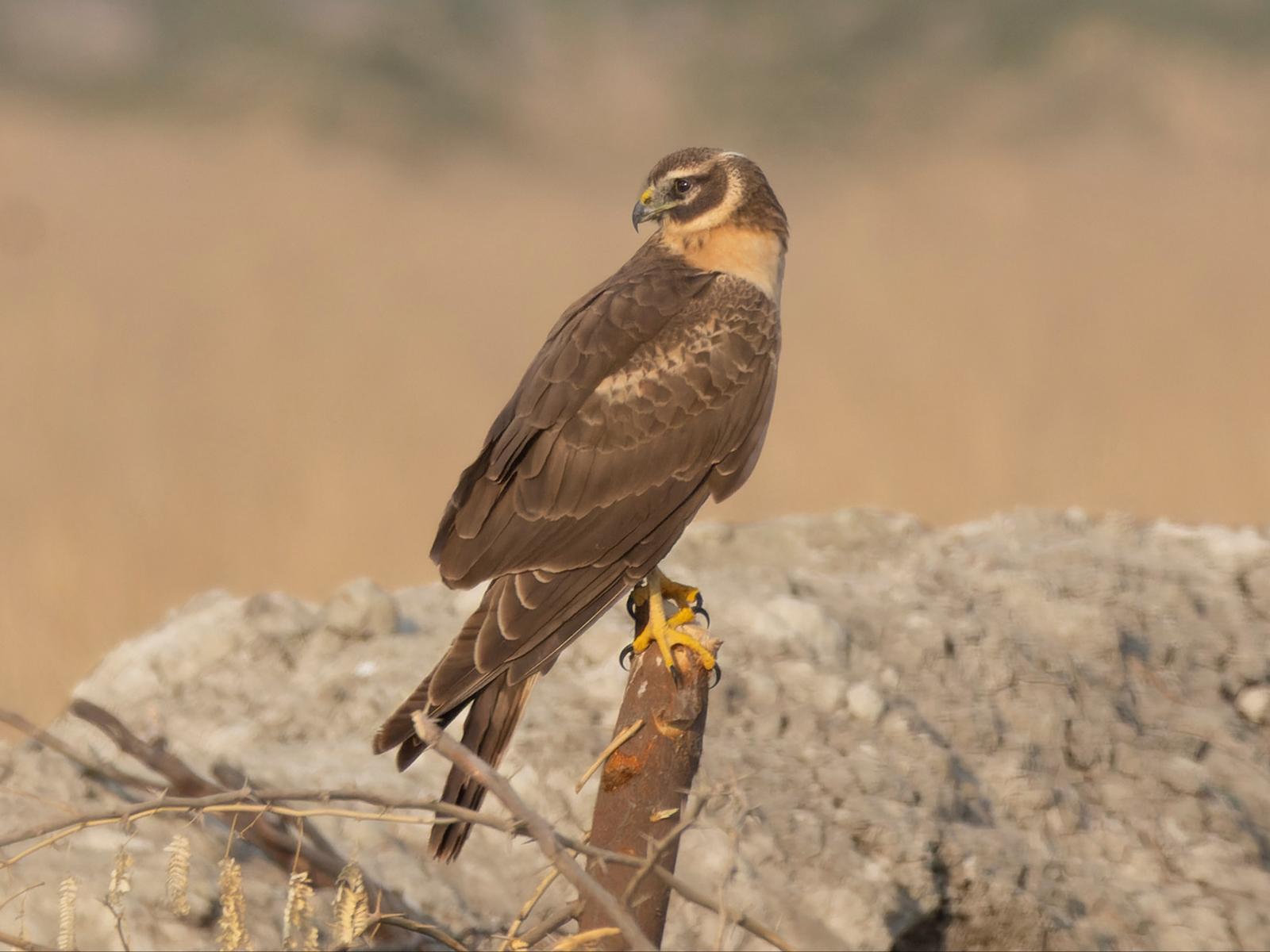
Pallid Harrier
📷Tisha Mukherjee — Own work (Wikimedia Commons) · CC-BY-SA-4.0
Field marks

A slim, pointed-winged harrier, between Hen and Montagu's in size and shape, with a narrower and more pointed than Hen Harrier. The male is pale pearl-grey — clearly paler than the other harriers, especially on head and breast — with a black wedge out in the hand, isolated by white on all sides and with no dark to the wing. The wedge is not always narrow: in older males it can broaden towards the wingtip. The is white, but stands out less than a Hen Harrier's.

Can be confused with

  • Hen Harrier — Male Hen Harrier is a darker grey, black right out to the wingtip, and shows a dark trailing edge along the whole wing. The Pallid’s black wedge stands isolated out in the hand, and the arm is clean.
  • Montagu's Harrier — Male Montagu's Harrier has a black band across the secondaries and a three-toned upperside; the Pallid's black is confined to the isolated wedge in the hand, and its upperside is uniformly very pale. Both show four "fingers", so finger-counting does not separate them.

Plumage and variation

Male and female: The male is easily told by his pale plumage. The female, by contrast, is very hard to separate from Montagu's in particular, and is easily confused with a female Hen Harrier too — only details of the face pattern will serve.

Juvenile: The immature has a warm orange-brown underside and — unlike an immature Montagu's — a distinct pale collar. Younger males, by contrast, are not yet fully patterned: they can show a dark trailing edge on the arm that fades outwards, while the hand is already clean and adult-like. That combination is what makes a young Pallid look like a Hen Harrier, and it is why the arm alone settles nothing.

Behaviour

Less springy in flight than the other harriers, a little more buzzard-like. In behaviour and general biology it otherwise closely resembles Montagu's. In Denmark it is seen mostly at the larger migration watchpoints.

When and where

A rare passage visitor from eastern Europe and Central Asia; the nearest breeding grounds lie in the Romanian and Russian steppes. It began appearing here in earnest after 2000, and a 2020 field guide put the level at 50-100 birds a year, with considerably more in invasion years. That figure is not brought up to date here: DOF's own reporting points to markedly higher numbers, and the species no longer requires documentation by DOF's rarities committee, but we have not found a newer source giving a comparable count. Most occur in spring, in April and May, and in invasion years in autumn too. Winters in tropical East Africa, Asia Minor and India.

Facts

Wingspan

109 cm

Conservation status

næsten truet

Relatives

Family

hawks, kites and eagles

Accipitridae

Order

hawks and eagles

Accipitriformes

Community field marks

Know this bird? Share how you recognise it with other birders.

No field marks yet. Be the first to share how you recognise this bird!

What makes it recognisable?

Tap the ones that fit this bird.

Test yourself in the quiz
QuizDailyResultsAbout