
Common Linnet
Linaria cannabina
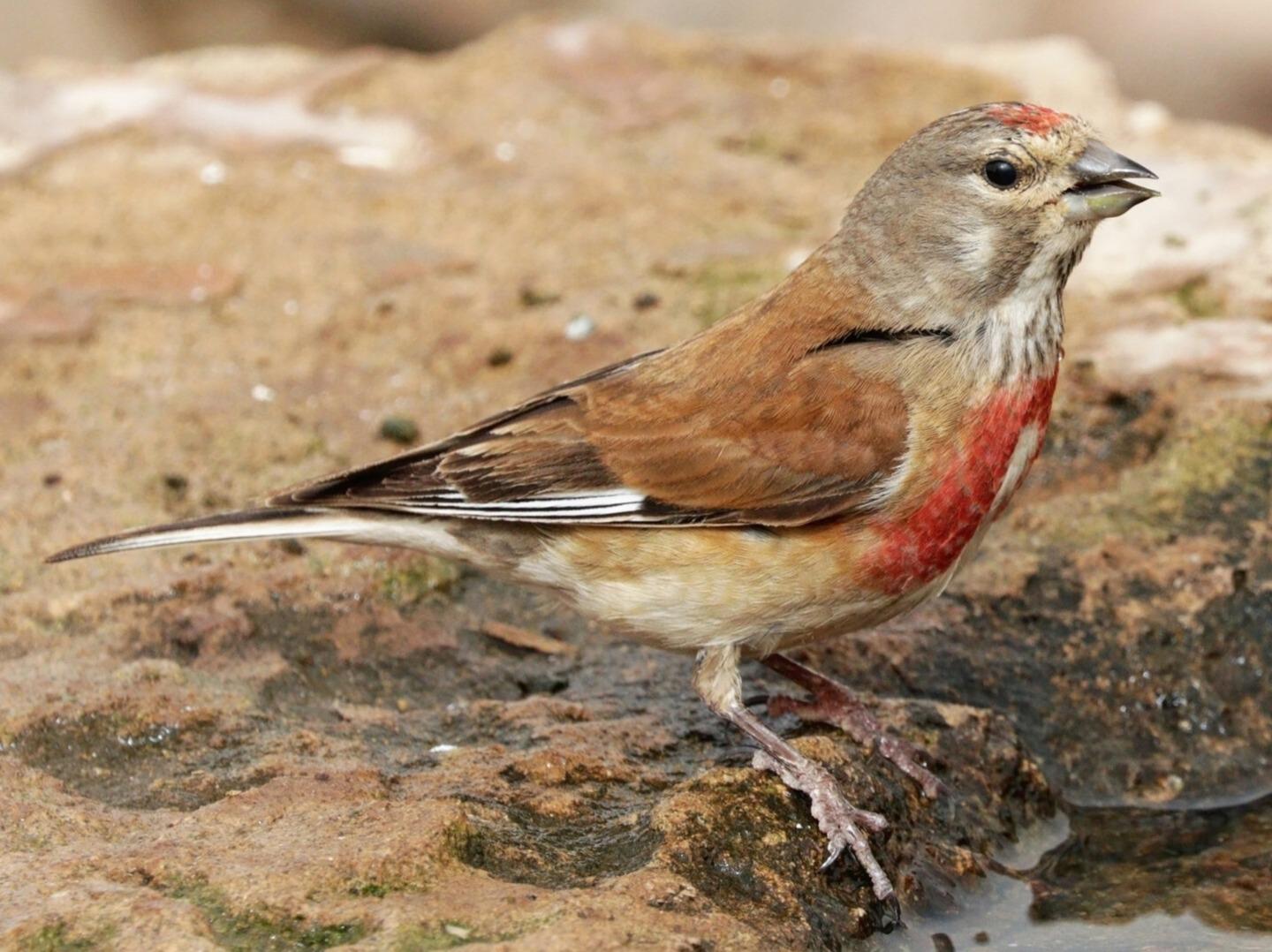
Tornirisken er en finke i ordenen spurvefugle. Fuglen yngler i Europa mod øst til det vestlige Sibirien og Aralsøen og mod syd til Lilleasien, det nordlige Afrika og De Kanariske Øer.
A short grey bill, long tail and slim body mark this small . The summer male has a cinnamon-brown back and rose-red forehead and breast. Fresh feather margins partly hide this red in autumn, giving a browner appearance. Females lack red: look for grey-brown and streaks below. Flight undulates and may end in a sudden drop.
Can be confused with
- Twite — Twite has an unstreaked throat, heavier streaking and darker, buffier upperparts rather than Linnet’s cinnamon-brown back. In winter Twite’s bill is yellow while Linnet’s is grey.
- European Goldfinch — A broad yellow bar on a black wing belongs to Goldfinch and is absent in Linnet. The bar is also present on young Goldfinches without a red face.
Voice
The call is a gentle "tsu-it"; in flight, listen for the more metallic repeated "tjit". The twittering song includes "tsu-it" and may come from an exposed twig or a bird hovering in song-flight.
Facts
Wingspan
24 cm
Conservation status
ikke truet
Family
finches
Fringillidae
Read more
This is a short overview for the quiz. For the full account, go to the sources:
- Danmarks Fugle at the Danish Ornithological Society (in Danish)
- Wikipedia (in Danish)The description above is from Wikipedia (CC BY-SA 4.0).
This page brings together information from several sources. If you spot a mistake, write to hallo@magnify.dk.