
White Stork
Ciconia ciconia
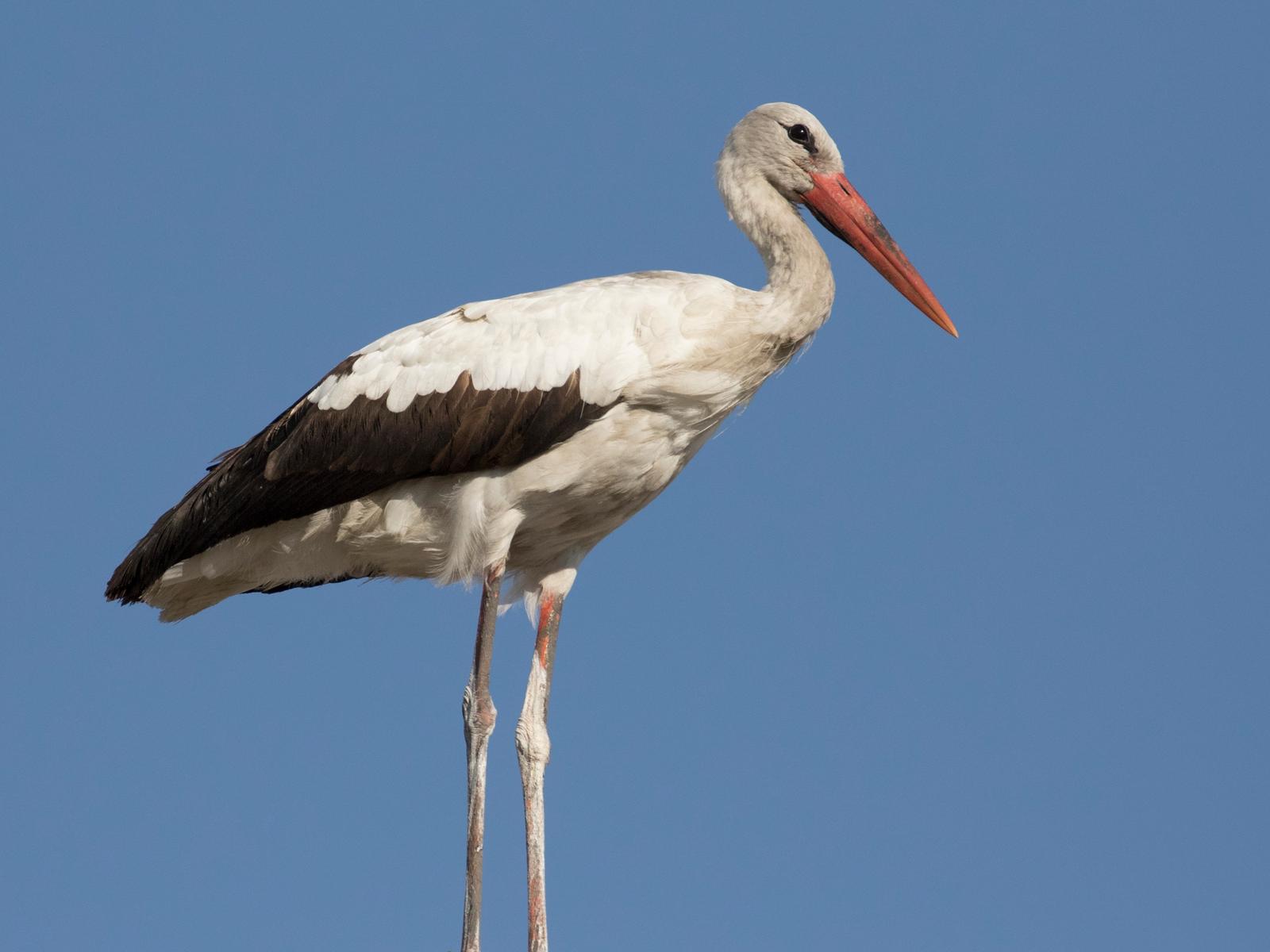
Hvid stork eller almindelig stork er en fugl i familien af storke, der er udbredt i dele af Europa, Afrika og Asien. I Danmark var storken tidligere en almindelig ynglefugl, men er nu meget sjælden, med ti ynglepar i 2023.
Red legs and bill contrast with a very large white body and black wing feathers. In flight the neck is extended, the wingtips fingered and wingbeats heavy; glides are frequent. The black-and-white contrast is also clear from above.
Can be confused with
- Grey Heron — Grey Heron has grey plumage and a yellow bill, whereas White Stork has black-and-white plumage and a red bill. Neck position adds a flight distinction: folded in the heron, extended in the stork.
- Eurasian Spoonbill — Spoonbill shares the stork’s extended neck in flight. It is smaller, however, with white plumage lacking black wing patches, black legs and a bill broad and flat at the tip.
Voice
Rapid repeated bill-clattering is the characteristic sound at the nest.
Facts
Wingspan
191 cm
Conservation status
ikke truet
Family
storks
Ciconiidae
Read more
This is a short overview for the quiz. For the full account, go to the sources:
- Danmarks Fugle at the Danish Ornithological Society (in Danish)
- Wikipedia (in Danish)The description above is from Wikipedia (CC BY-SA 4.0).
This page brings together information from several sources. If you spot a mistake, write to hallo@magnify.dk.