Fuglequiz
QuizDailyResultsAbout

Eurasian Spoonbill

Platalea leucorodia
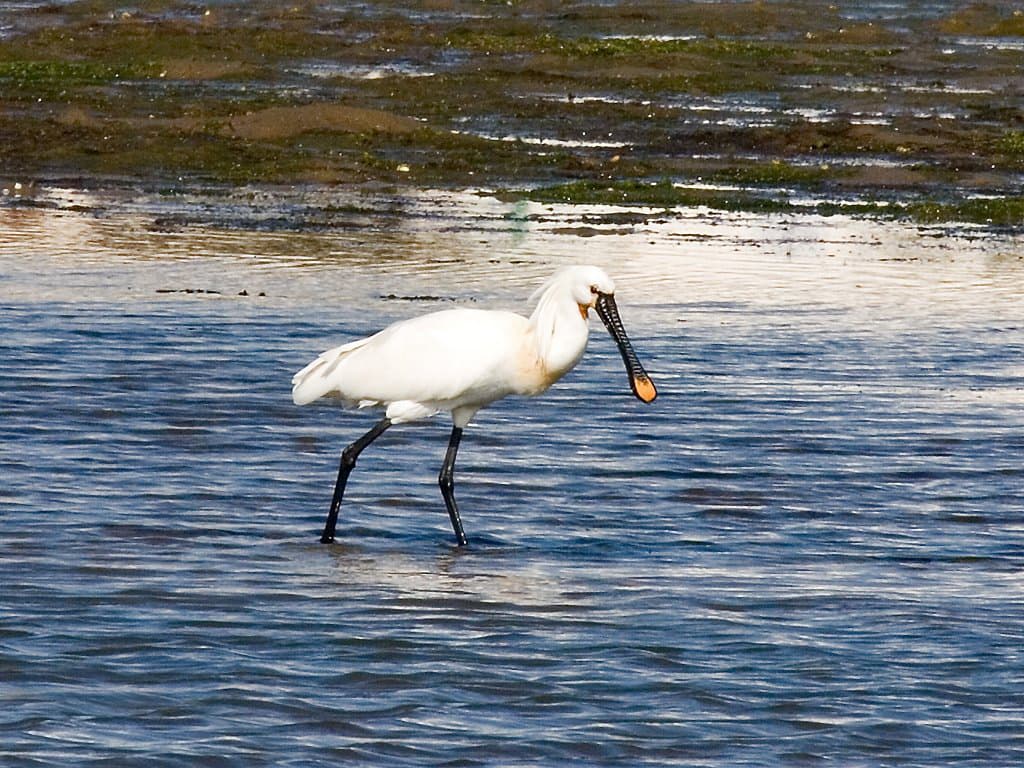
Eurasian Spoonbill
📷Vlaskop — https://www.flickr.com/photos/28820410@N03/3320444072/ (Wikimedia Commons) · CC-BY-2.0

Skestorken er en fugl, der lever i vådområder og er en smule mindre end fiskehejren. Den er hvid og har et bredt langt næb.

Field marks

A large white wading bird with long black legs and a bill like nothing else: long, black and flat, widening at the tip into a broad plate like a spoon. Somewhat smaller than a Grey Heron. In breeding dress it carries a shaggy yellowish crest at the nape and an ochre patch on the breast. In flight the head and neck are held straight out.

Can be confused with

  • Great Egret — Great Egret is also large and white, but flies with the neck folded into an S against the body, where Spoonbill holds head and neck straight out. And the bill settles it: the egret's is pointed and dagger-like, the Spoonbill's flat with a spoon at the tip.
  • White Stork — White Stork is bigger, with red legs, a red bill and large black areas in the wing. Spoonbill is all white with black legs and a black bill.

Behaviour

The feeding action is the signature: the bill is pushed deep into the water and swung steadily from side to side, working as shovel and sieve at once as the bird takes small fish and other water life. Nests close together in colonies in large, open, shallow marshes with reedbed; adults and young trample the vegetation until the colony sits like a clearing in the reeds — though still well hidden.

When and where

No longer a rare visitor. Spoonbill was absent as a Danish breeder for many years, returned in 1996 on an islet in Nibe Bredning and gained a colony in the restored Skjern Ådal in 2002. It has moved fast since: 438 pairs in 2023 and 623 pairs across seven colonies in 2024, spreading from the Limfjord to Ringkøbing Fjord and the Wadden Sea. Small and large flocks are seen through summer and autumn, above all in Jutland. The 2019 Red List has it as Least Concern and increasing, but files it under 1,000 mature individuals — a threshold the population has since passed. Winters in north and west Africa, a few in western Europe.

Facts

Wingspan

130 cm

Conservation status

ikke truet

Relatives

Family

ibises and spoonbills

Threskiornithidae

Order

pelicans and herons

Pelecaniformes

Community field marks

Know this bird? Share how you recognise it with other birders.

No field marks yet. Be the first to share how you recognise this bird!

What makes it recognisable?

Tap the ones that fit this bird.

Test yourself in the quiz
QuizDailyResultsAbout