
Eurasian Siskin
Spinus spinus
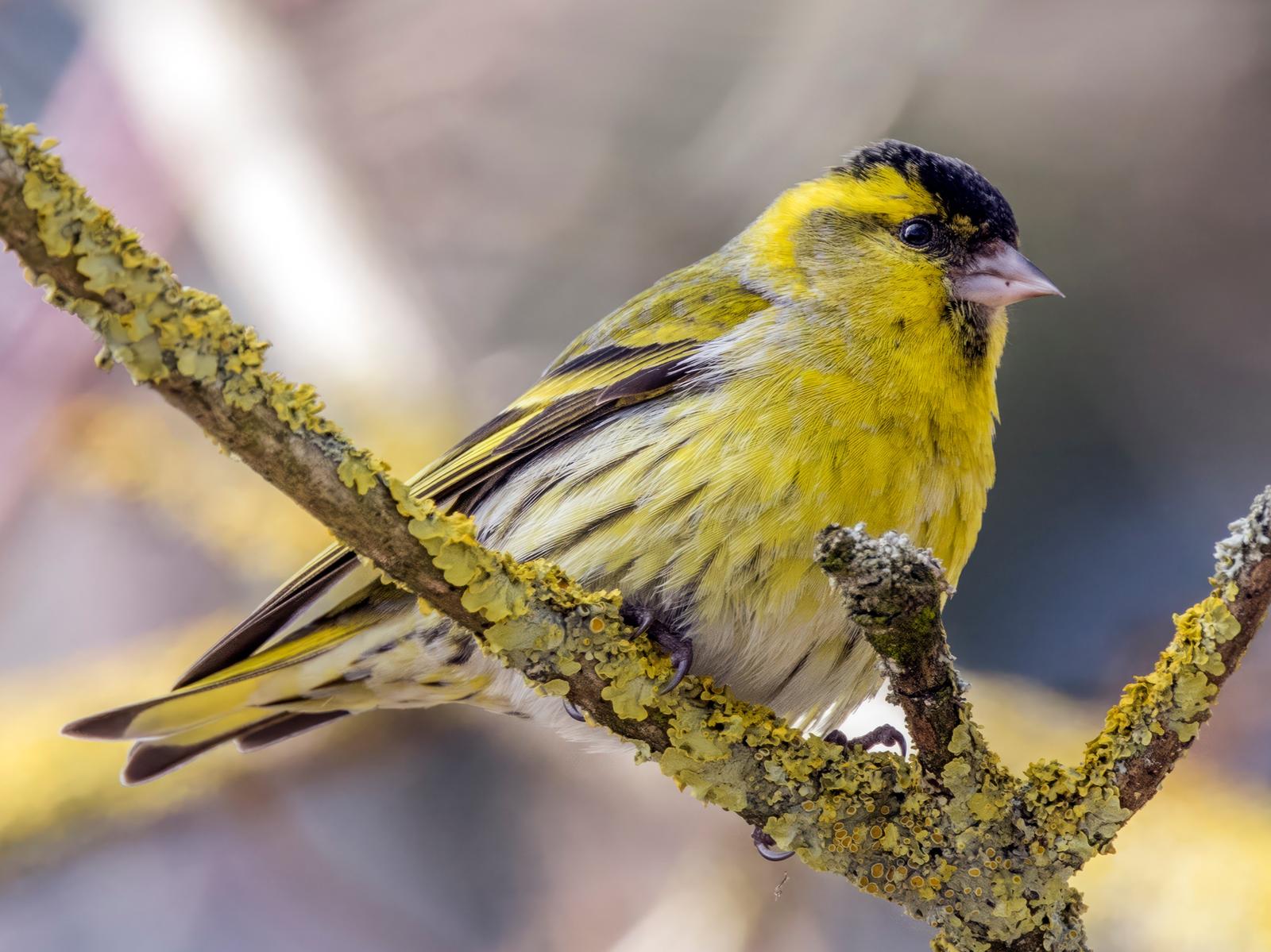
Grønsisken er en lille spurvefugl i finkefamilien, som er udbredt i store dele af Europa og Asien. I yngleperioden holder den sig hovedsageligt til nåleskove, men kan resten af året ses i små flokke på jagt efter frø fra birk, el, lærk og rødgran.
A fine pointed conical bill and deeply forked tail belong to this small streaked yellow-green . The wing has a broad yellow band, clear in flight alongside the tail fork. Black on the and chin marks the male.
Can be confused with
- European Greenfinch — Greenfinch has a larger, more compact body and thicker bill. Its plain adult plumage differs from Siskin’s clear streaking; black on the male Siskin’s crown and chin is another useful distinction.
- European Goldfinch — Goldfinch’s sandy-brown body and black-and-white head differ from Siskin’s streaked yellow-green plumage. Goldfinch has a broad yellow patch on a black wing.
Voice
A high fine two-syllable "sy-li" or "si-ly" is often heard from birds flying overhead. The song consists of rapid broken phrases and typically ends with a long "æææh", reminiscent of Greenfinch.
Facts
Wingspan
21 cm
Conservation status
ikke truet
Family
finches
Fringillidae
Read more
This is a short overview for the quiz. For the full account, go to the sources:
- Danmarks Fugle at the Danish Ornithological Society (in Danish)
- Wikipedia (in Danish)The description above is from Wikipedia (CC BY-SA 4.0).
This page brings together information from several sources. If you spot a mistake, write to hallo@magnify.dk.