
Common Starling
Sturnus vulgaris
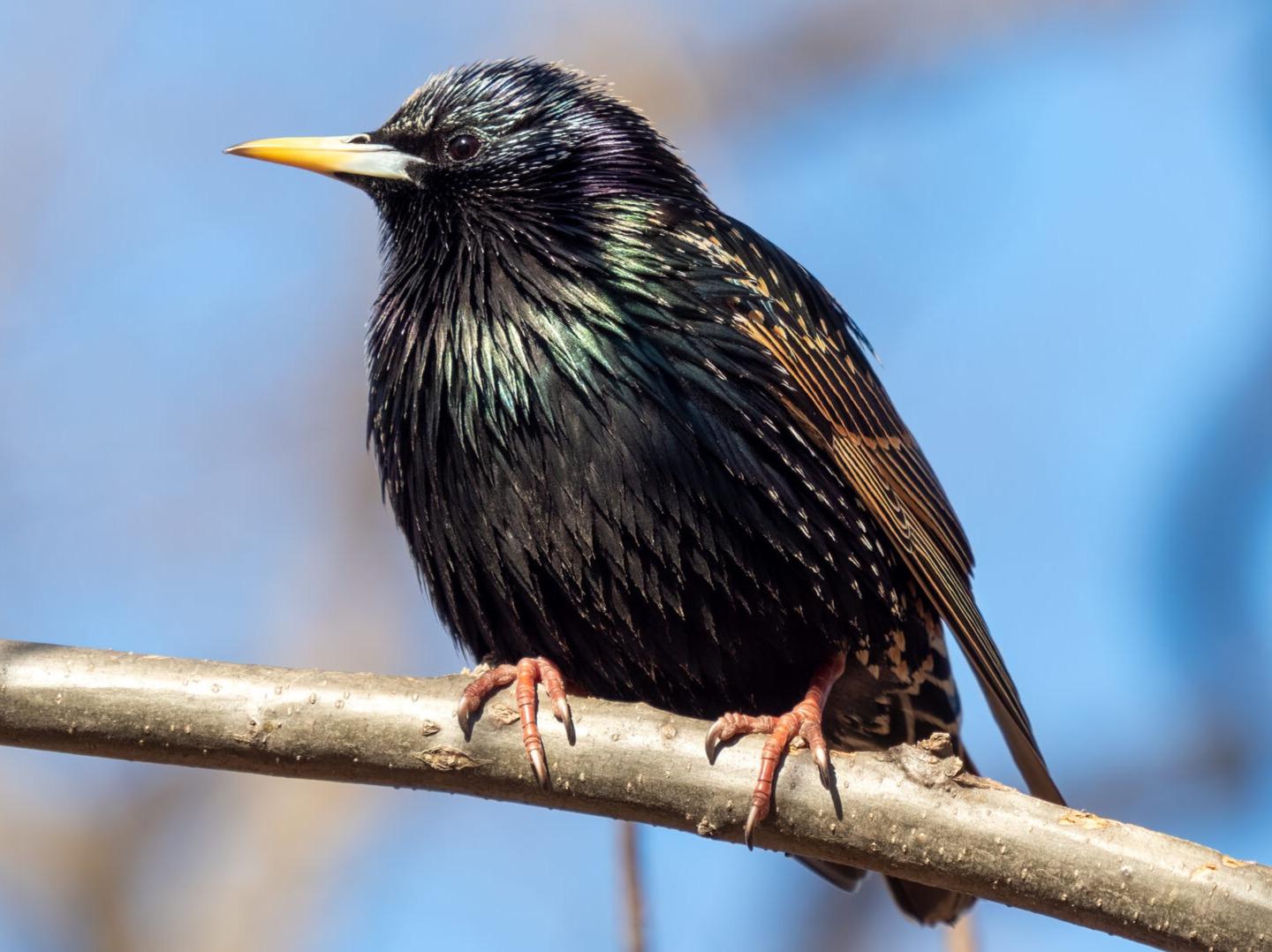
Stæren er en spurvefugl, der er udbredt over store dele af verden. Den er kendt for sin smukke sang om foråret og sine store flokke, der især om efteråret danner sort sol.
Compact, short-tailed songbird with a long, pointed bill and reddish legs. Breeding: glossy black with a green-purple metallic sheen and a yellow bill. Non-breeding: heavily white/buff-spotted all over with a dark bill. In flight, triangular pointed wings and a short tail.
Can be confused with
- Common Blackbird — Blackbird is larger with a long tail, matte black (male) or brown (female) with no metallic sheen or spots, and hops on the ground — the starling walks and runs. The blackbird's bill is shorter and curved, not long and pointed.
Voice
A very varied, sustained song from an open perch: whistles, clicks, rattles and sharp mimicry of other birds (and sounds like phone ringtones), often with a drawn-out descending whistle "tsheeoo". Call a harsh "tcheer".
Facts
Wingspan
38 cm
Conservation status
ikke truet
Family
starlings
Sturnidae
Read more
This is a short overview for the quiz. For the full account, go to the sources:
- Danmarks Fugle at the Danish Ornithological Society (in Danish)
- Wikipedia (in Danish)The description above is from Wikipedia (CC BY-SA 4.0).
This page brings together information from several sources. If you spot a mistake, write to hallo@magnify.dk.