
Northern Goshawk
Accipiter gentilis
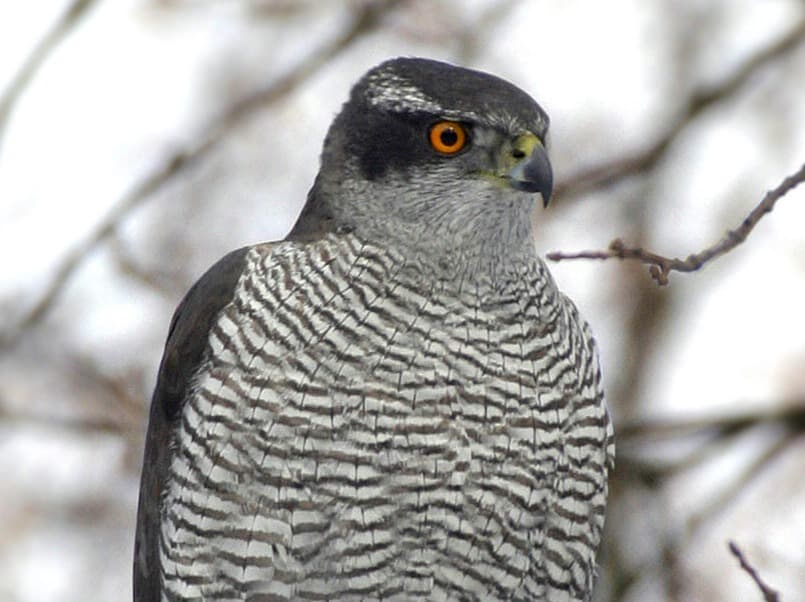
Field marks
A deep chest, short rounded wings and long tail give this a powerful build. The female is Buzzard-sized, the male clearly smaller. are grey-brown above and densely barred below, with a white . Flight shows a white patch at the tail base and deep wingbeats alternating with short glides.
Can be confused with
- Eurasian Sparrowhawk — Sparrowhawk is smaller and more lightly built, with faster lighter wingbeats. Goshawk’s stronger supercilium is used together with build and flight. Sparrowhawk is often seen in gardens, while Goshawk mainly keeps to woodland.
- Common Buzzard — The wing-to-tail proportions help: Goshawk’s tail is long relative to its short wings, which have rounded tips. Buzzard has broader wings. Low, direct hunting flights through trees also suit Goshawk.
Voice
Hard "gek" notes repeat in a call series, "gek-gek-gek".
Facts
Wingspan
100–115 cm
Conservation status
ikke truet
Family
hawks, kites and eagles
Accipitridae
Read more
This is a short overview for the quiz. For the full account, go to the sources:
This page brings together information from several sources. If you spot a mistake, write to hallo@magnify.dk.