
Common Chaffinch
Fringilla coelebs
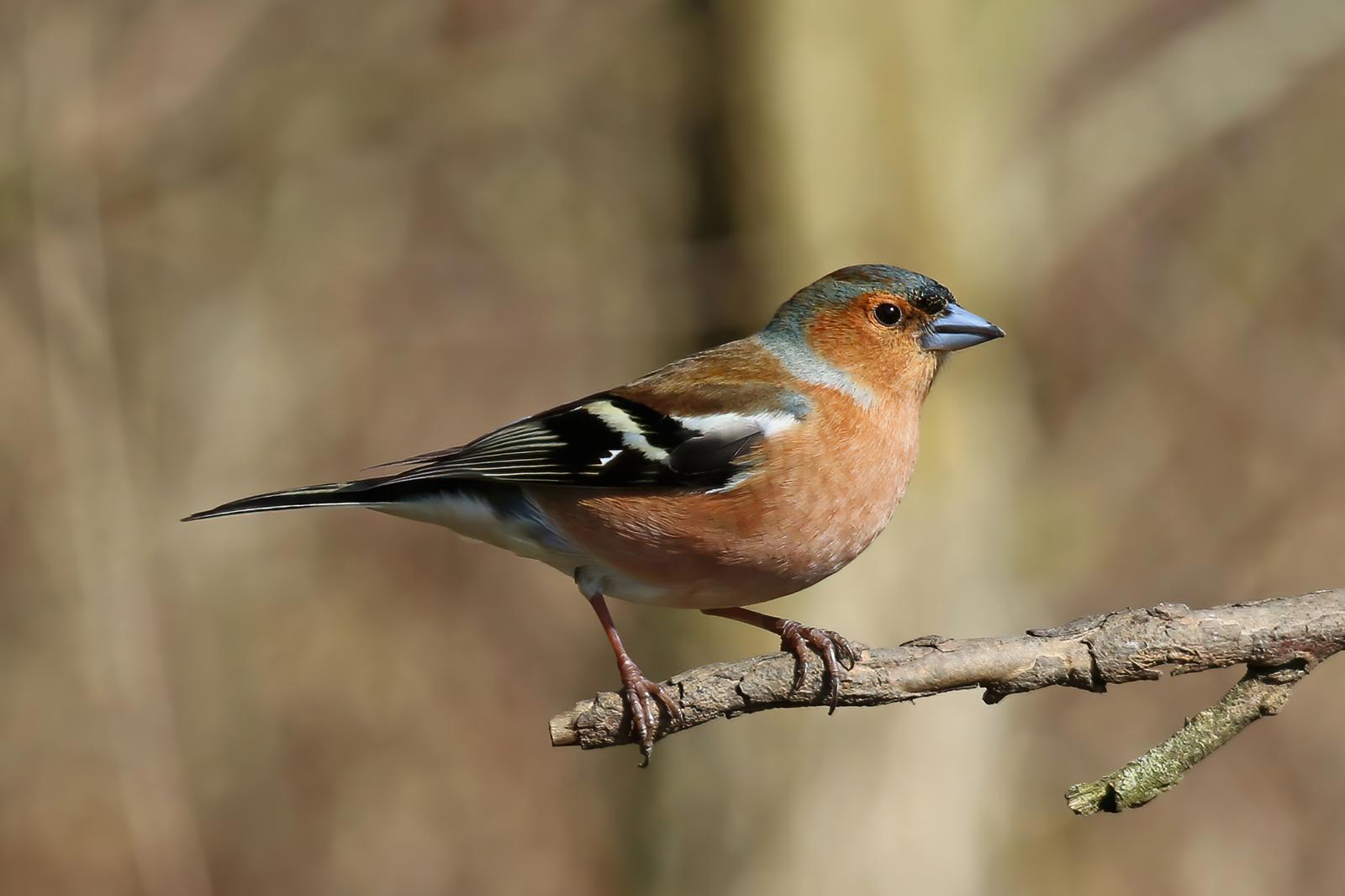
Bogfinken er en 16 centimeter stor spurvefugl, der yngler i store dele af Europa og mod øst til Centralasien. Arten er desuden indført til New Zealand.
Slim with two bold white , a white shoulder patch and white outer tail feathers. In the male the and nape are blue-grey and the face and breast pinkish-brown; the female is greyer-brown but shows the same white wing markings.
Can be confused with
- Brambling — Brambling has an orange (not pink) breast and shoulder and a white rump seen in flight; often in mixed flocks in winter.
- House Sparrow — House Sparrow lacks the white wingbars and white outer tail and has a heavier, conical bill.
Voice
The song is a firm, accelerating phrase that runs down the scale and ends in a jaunty flourish. The call is a clear, metallic "pink pink", and in spring a monotonous, repeated "huit" — the so-called rain call.
Facts
Wingspan
26 cm
Conservation status
ikke truet
Family
finches
Fringillidae
Read more
This is a short overview for the quiz. For the full account, go to the sources:
- Danmarks Fugle at the Danish Ornithological Society (in Danish)
- Wikipedia (in Danish)The description above is from Wikipedia (CC BY-SA 4.0).
This page brings together information from several sources. If you spot a mistake, write to hallo@magnify.dk.