Red Crossbill
Loxia curvirostra
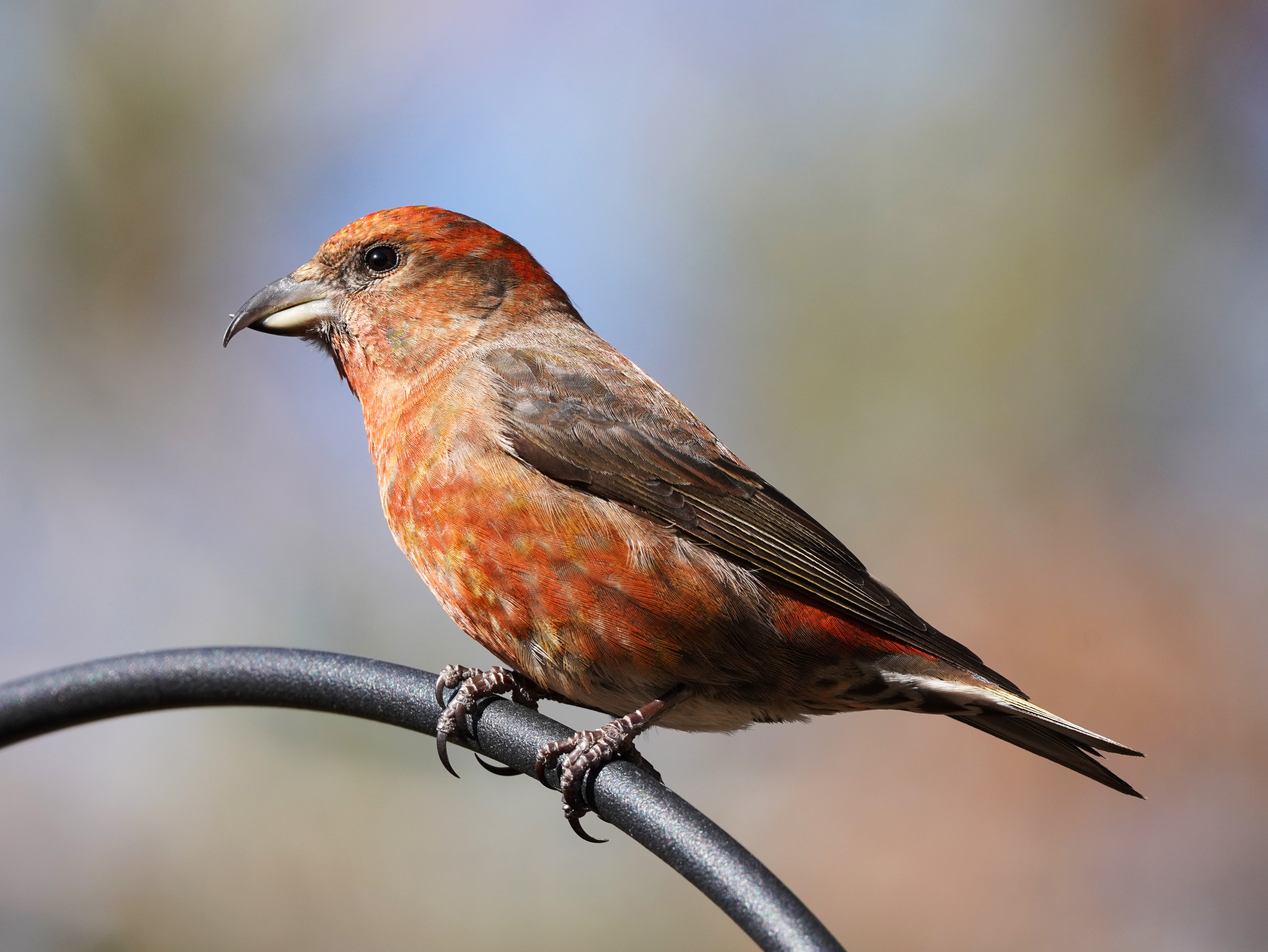
Lille korsnæb er en fugl i familien finker, der er udbredt i nåleskovene i Europa, Asien og Nordamerika. Arten kan med sit specielle næb åbne koglerne og derved komme til frøene.
A fairly large, robust with long, pointed wings and a short, forked tail. The bill is very heavy and its tips cross when closed — a certain mark no other Danish finch has. The male is largely deep red, strongest on the , with brown-black wings; the female is grey-brown with a greenish cast, a yellow-green rump and a dull green underside.
Can be confused with
- Parrot Crossbill — Parrot Crossbill is the hard one: both have crossed bills, and size rarely helps in the field. Bill shape decides it — Parrot Crossbill's is deeper and more parrot-like, where Red Crossbill's looks slimmer for its length. In practice the call is the more usable cue: Red Crossbill's metallic "gyp-gyp" against Parrot Crossbill's deeper, nasal "døb-døb".
Plumage and variation
Male and female: The male's reds range from nearly pillar-box red to a more orange red, and a few males are even greenish, with only patches of orange-red.
Juvenile: The immature is grey-brown with a heavily streaked upperside.
Voice
The call sounds almost continuously from birds in flight: insistent, metallic "gyp-gyp" notes. The song is a varied assembly of creaking, snarling and twittering sounds.
Behaviour
Clambers about spruce branches with parrot-like agility, the bill perfectly specialised for twisting cone scales apart and prising out the seeds. That single-minded diet has made the crossbills nomads, living in small flocks almost always on the move towards areas with a good cone crop. As a further adaptation the species breeds in midwinter, while spruce cones still hold ripe seed, so a female may be incubating or feeding young in January or February in fifteen to twenty degrees of frost.
When and where
A scarce Danish breeder, most numerous in Jutland, and a fairly common passage and winter visitor over most of the country. The population was put at 80-516 pairs in 2024 and 413 in 2018; the wide span is the point, since breeding numbers swing with the spruce seed crop from year to year rather than following any trend — the 2019 Red List (LC) accordingly gives the trend as unknown. The species leads a wandering life with movements both north and south for most of the year; birds from the north can arrive in large numbers, especially when the cone crop fails up there, and in some years the invasions begin as early as late summer.
Facts
Wingspan
29 cm
Conservation status
ikke truet
Relatives
Family
finches
Fringillidae
Order
passerines
Passeriformes
Know this bird? Share how you recognise it with other birders.
No field marks yet. Be the first to share how you recognise this bird!
Tap the ones that fit this bird.